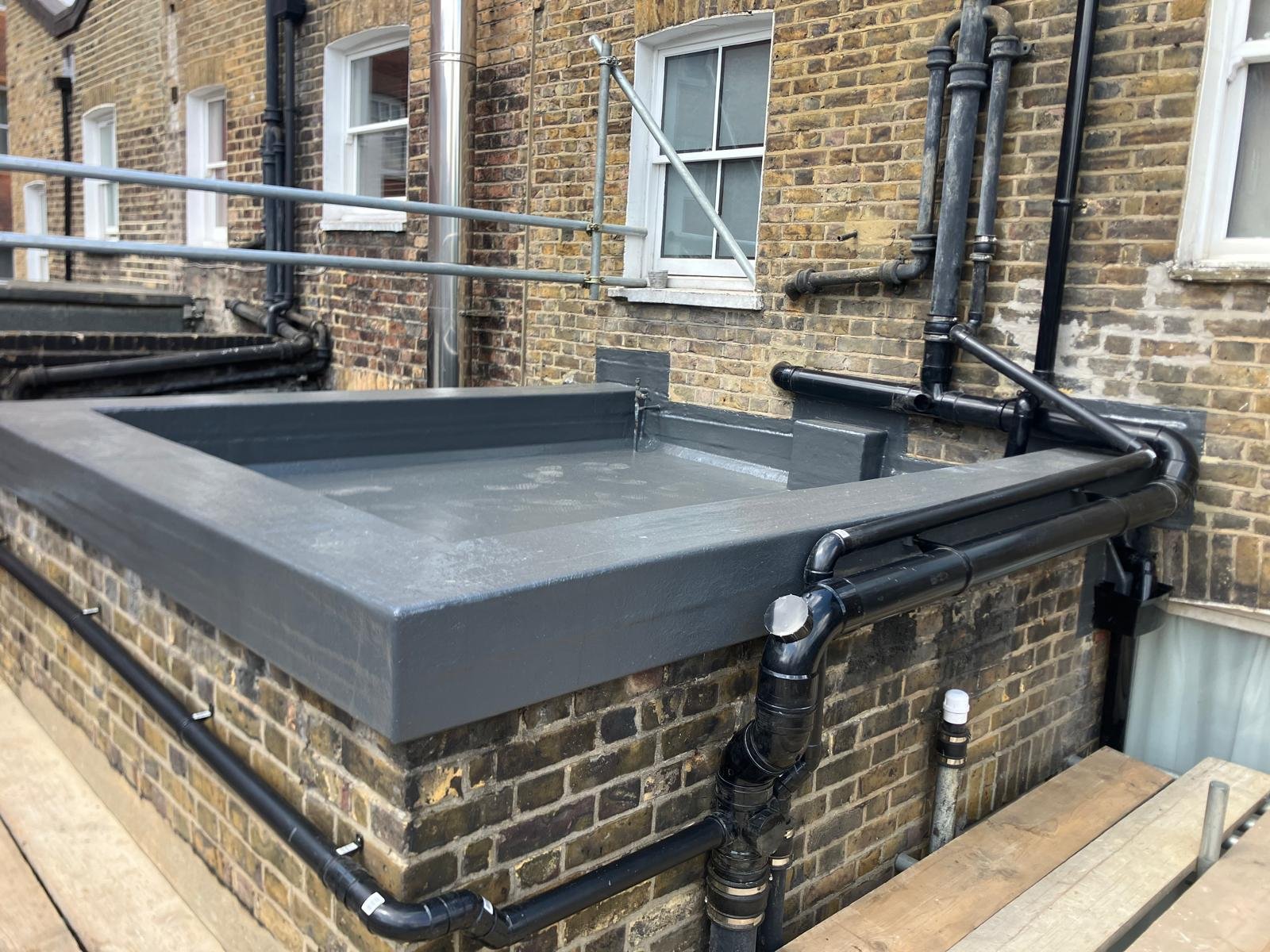
A flat roof needs more than a waterproof surface. Falls, edges, upstands, outlets and penetrations all need correct detailing if the roof is going to manage rainwater and protect the building below. For homeowners researching fibreglass roofing in De Beauvoir Town, understanding these details is important. Fibreglass systems can provide a practical, seamless covering for many flat and low-pitched roofs, but the preparation and installation matter just as much as the material itself.
BARL has more than 25 years’ experience in roofing and building restoration across London. Our work includes flat roofing and waterproofing alongside pitched roofing, natural slate, leadwork, brickwork and chimney restoration, with particular experience of Victorian and period properties.
The photographs below are examples of BARL’s flat roofing work. They show the sort of complex junctions and roof penetrations that need careful attention on a waterproofed flat roof.

What is fibreglass roofing? A guide for De Beauvoir homes
Most roofers call fibreglass roofing GRP roofing, which stands for glass reinforced plastic. Rather than using individual tiles or slates, a fibreglass roof creates a continuous waterproof covering across the roof area. A correctly specified system builds reinforcement into resin to form the waterproof layer, then finishes the surface with a topcoat.
This makes it particularly useful for flat and low-pitched roofs, where a continuous weatherproof covering is important. However, a good installation is not simply a matter of coating the visible roof. The substrate, falls and all the perimeter and penetration details need to suit the system.
Where fibreglass roofing suits De Beauvoir properties
A fibreglass flat roof in De Beauvoir Town can suit a range of domestic roofs, depending on the construction and condition. Typical uses include flat roofs on extensions, bays and other areas where a continuous covering makes sense.
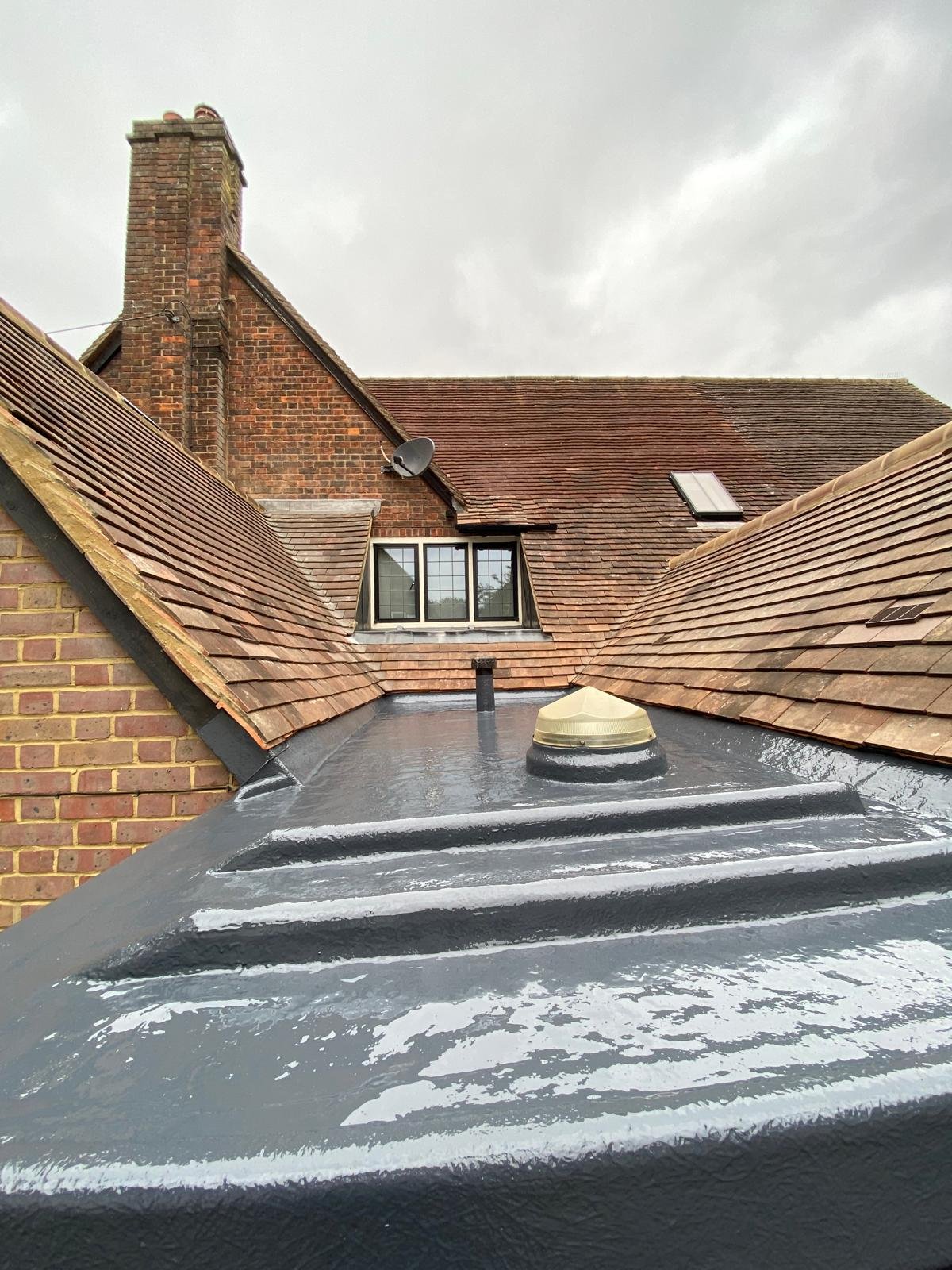
The photographs show a more involved arrangement. The waterproofed flat section sits between surrounding pitched tiled roofs and includes several changes of level, perimeter junctions and roof penetrations. These are exactly the details that show why you should treat a flat roof as a complete system.
Benefits of GRP fibreglass roofing
There are several reasons to consider GRP roofing in De Beauvoir Town when a suitable flat roof needs repair or replacement.
A continuous waterproof surface
One of the main advantages is a largely seamless covering. Fewer joints simplify waterproofing across the main roof area. But the roof will still have critical details around its perimeter, outlets, penetrations and connections to other materials, and those areas need especially careful installation.
Suitable for detailed roof areas
Flat roofs are rarely simple rectangles. They may meet walls, pitched roofs or parapets and include rooflights, vents and pipes. A reinforced liquid-applied system can handle detailed areas when the system and substrate are suitable and the installation is done correctly.
A clean finished appearance
Fibreglass systems give a neat, consistent finish, which helps when a flat roof is visible from upper floors. Appearance, though, should always come second to proper weatherproofing and drainage.
★★★★★
“Installed a new fibreglass roof. Professional, reliable and neat. The roofer we worked with is extremely knowledgable and experienced. Explains things very well. Highly recommended.”
Roman C. · Google review, 2023
Good fibreglass roofing installation in De Beauvoir Town
The finished surface is only the part of a flat roof you can see. Its long-term performance depends on what happens underneath and around it.
Substrate preparation
A waterproofing system needs a suitable, stable substrate. Installing a new covering over defective construction can leave problems unresolved. So before substantial work begins, we assess the existing roof to decide the right approach.
Correct roof falls and drainage
Flat roofs aren’t meant to hold standing water. They need falls so rainwater moves towards the drainage points. Persistent ponding can point to a problem with the falls, drainage or local levels, and another layer of waterproofing shouldn’t simply hide it.
Edges, upstands and penetrations
Waterproofing must continue correctly at roof edges and wherever the roof meets a vertical surface. Every rooflight, vent and pipe also interrupts the main surface. The photographs show this clearly: the flat roof includes a rooflight and a pipe, while also meeting several surrounding roof slopes. Whatever the specification, details like these need careful integration into the covering.
Common problems with fibreglass and flat roofs
A leaking flat roof doesn’t necessarily mean the entire roof has failed. Problems can develop around local details as well as across the main covering. Typical warning signs include:
- Cracking or visible damage to the waterproof surface.
- Water coming in, or damp inside.
- Defects around rooflights or penetrations.
- Problems where the flat roof meets a wall or pitched roof.
- Persistent areas of standing water.
- Deterioration around edges and upstands.
- Previous repairs beginning to fail.
Finding the actual entry point is important. Water can move beneath or through parts of a roof before it shows inside, so the damp patch doesn’t always mark the external defect. Our guide to a leaking roof explains why.
Fibreglass roof repairs or flat roof replacement in De Beauvoir Town?
Homeowners searching for fibreglass roof repairs in De Beauvoir Town often want to know whether a roof can be repaired rather than replaced. That depends on the cause and extent of the problem.
A local defect may be repairable if the wider roof and substrate are still serviceable. But if deterioration is widespread, the deck is unsuitable or patch repairs no longer solve the problem, a flat roof replacement in De Beauvoir Town may need considering. A professional inspection shows whether the defect is isolated, whether surrounding details contribute, and which approach is right. Our guide to flat roof repair or replacement compares GRP, felt and EPDM.
Roof junctions need particular attention
Complex roof junctions are where roofing experience really counts. A flat roof may need to connect with pitched tiles or slates, brickwork, parapets, chimneys or other waterproofing materials. Each change of material creates a detail that needs careful thought.
In the photographs, several tiled slopes feed towards or adjoin the lower waterproofed area, while masonry and several penetrations are also present. Rainwater needs a continuous route across the roof and into the drainage system, without finding a way behind the waterproofing. So our experience across roofing, leadwork, brickwork and chimney restoration is especially relevant where these elements meet.
Flat roofing on Victorian and period properties
Roofing work on a period property often needs more than choosing a modern waterproofing product. Existing masonry, pitched roofs, parapets, chimney stacks and traditional materials can all affect the right approach to a flat roof. Changing one part without considering the adjoining construction can create problems elsewhere.
Our aim is to understand how the whole roof is put together before deciding on repair or replacement. This matters most when previous owners have altered or patched a flat roof several times, because layers of old work can hide the source of a leak.
Insulation and ventilation
If you are replacing a flat roof, it is a good time to consider insulation and ventilation. The right approach depends on the roof’s construction. Warm deck systems, for example, need every layer of the build-up designed and installed correctly. So always consider insulation together with waterproofing and moisture control. You can see a warm-deck GRP flat roof replacement in Islington in our project write-up.
★★★★★
“BARL has installed a GRP fibreglass roof + GRP-capped fibreglass parapet walls, and the transformation is remarkable. The process was smooth and efficient.”
Isabelle · Google review, 2025
Maintaining fibreglass roofing in De Beauvoir Town
Flat roofs benefit from occasional inspection, because drainage problems and small defects get worse if ignored. Keep an eye out for surface damage, keep visible outlets clear, and note any changes around rooflights, edges and penetrations. Avoid walking on the roof or attempting repairs without understanding the system, because an unsuitable patch can make later repairs harder.
Choosing a roofer in De Beauvoir Town
Flat roofing needs careful workmanship, especially around the details you can’t see from the ground. A contractor should look beyond the visible surface and consider drainage, substrate, penetrations, adjoining roofs and masonry. BARL is a family-run London contractor with more than 25 years’ experience. Our mix of roofing, waterproofing, leadwork, brickwork and chimney expertise means we assess roof problems in the context of the whole building. We work across De Beauvoir Town and the surrounding area, including Hackney and Islington. See all our roofing services.
Need advice about fibreglass roofing in De Beauvoir Town?
Whether you have a leaking flat roof, worn waterproofing or you’re considering a replacement, the first step is establishing the condition of the existing roof and the cause of any problems.
Frequently asked questions
GRP stands for glass reinforced plastic. It is a fibreglass roofing system that combines reinforcement and resin to form a continuous, seamless waterproof covering, finished with a topcoat. Roofers widely use it on flat and low-pitched domestic roofs.
Often, yes, when the defect is local and the wider roof and deck are still sound. If deterioration is widespread, the substrate is unsuitable or repairs keep failing, a replacement may be more appropriate. An inspection confirms which applies.
Persistent standing water usually points to poor falls, local dips or blocked drainage. The waterproofing can’t cope with it indefinitely, so any repair or replacement should deal with the cause.
It can be, on suitable flat roof areas such as rear extensions and bays. On period properties, the junctions with brickwork, parapets, chimneys and traditional roofs need particular care so water can’t get behind the waterproofing.