If the faces of your bricks are flaking, crumbling or falling off in chunks, you have spalling bricks. On London’s Victorian terraces, spalling bricks are one of the most common problems we see. They are almost always a symptom of something else, such as trapped moisture, frost, salts or decades-old cement repairs. So if you fix the brick without fixing the cause, it will come back. This guide explains what causes spalling bricks and how to repair them properly.
What are spalling bricks?
Spalling is when the hard outer “fireskin” of a brick breaks away. Once that face has gone, the weather reaches the softer core, which then decays much faster. You’ll see it as flaking, pitting, powdering or whole faces of brick dropping off. It shows up especially near the ground, around downpipes, under window sills, and on chimneys and parapets where walls get wettest.
Main causes: cement mortar, frost, damp and sealants
Bricks suffer damage when they stay saturated, either through freeze-thaw action or where salts come to the surface. These are the usual reasons a London wall stays that wet:
- Hard cement mortar. Cement is harder and less breathable than soft London stock brick, so moisture leaves through the brick instead of the joint.
- Frost. When water inside a saturated brick freezes, it expands and pushes the face off. So a few hard winters can do a lot of damage.
- Leaking gutters, downpipes and copings. Constant wetting from a cracked hopper or a missing parapet coping is one of the commonest causes, and the easiest to fix.
- Masonry paints and sealants. Modern coatings can stop the wall breathing, which makes decay faster.
- Salts. Salts carried by moisture crystallise just under the surface and then break the face apart.
If hard cement joints are the problem, our guide to brick repointing with lime mortar explains the fix.
Can you repair spalling bricks without replacing them?
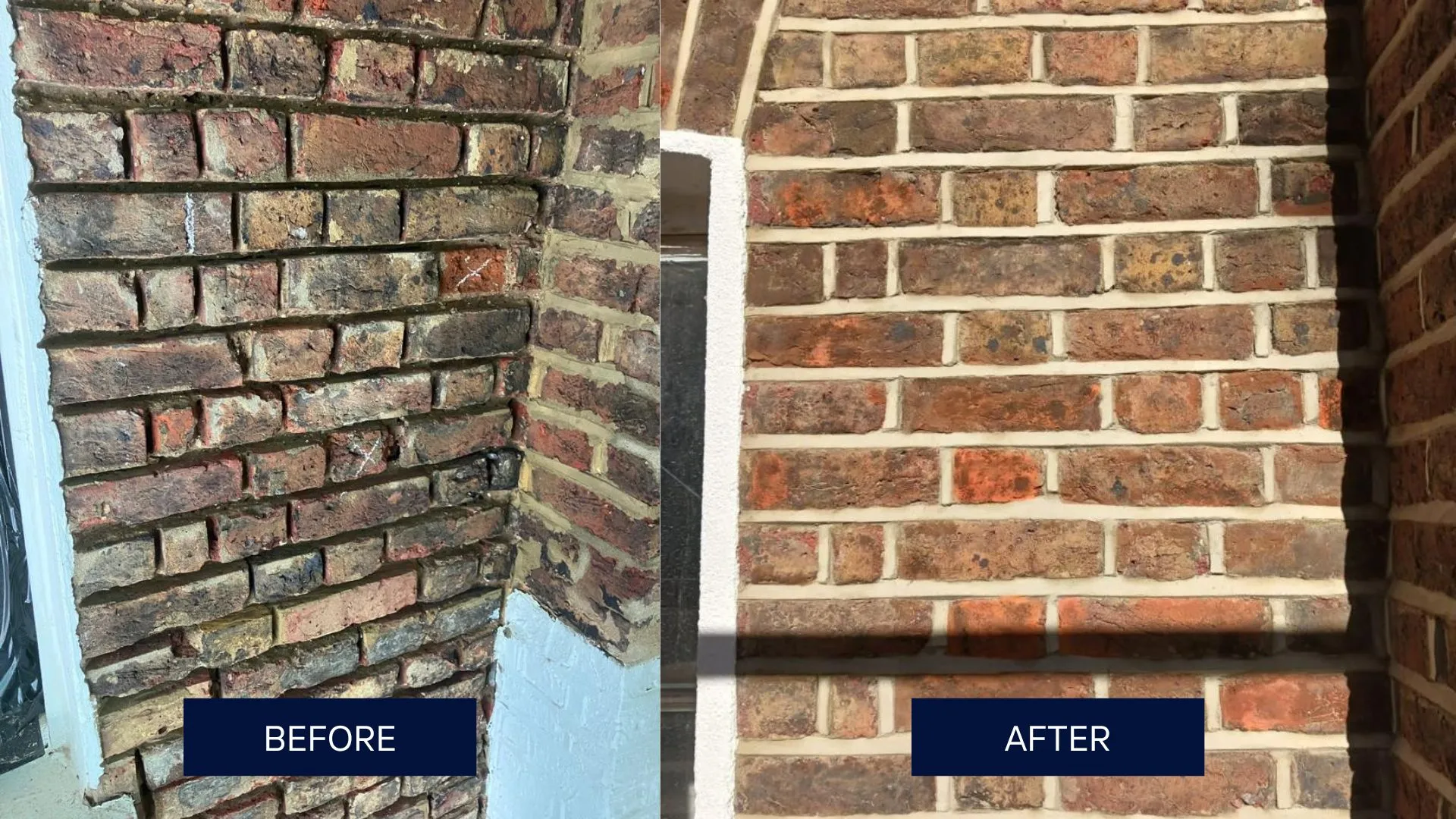
Sometimes. For example, if the damage is shallow and limited, stopping the cause and repointing in lime may be enough, and the brick can weather on gracefully. Repairs usually involve repointing and/or cutting out and replacing damaged bricks, with materials matched as closely as possible. However, filling spalled faces with cement or plastering over them doesn’t work long-term. That traps more moisture and spreads the problem.
Brick replacement, reversing and tinting
- Cut out and replace: the bricklayer carefully cuts out the damaged brick and replaces it with a matching reclaimed or new brick, bedded and pointed in lime.
- Reversing: when the back of the original brick is sound, the bricklayer removes it, turns it round and refits it so its good face shows.
- Matching: a good match looks at size, colour, texture and absorbency, not just colour.
- Tinting: where a replacement is close but not perfect, specialist tinting can blend it into the surrounding wall.
How to stop spalling bricks coming back
- Keep gutters, hoppers and downpipes clear, and fix leaks before they soak the wall.
- Make sure parapets and chimneys have sound copings and flashings. Our chimney repair guide covers this.
- Repoint in lime mortar that is slightly softer than the brick.
- Avoid masonry paints, cement renders and water-repellent sealants on period brick.
- Keep ground levels and paving below the damp-proof course so walls can drain.
- Clean brick gently if you clean it at all, because harsh methods strip the fireskin. See our guide to safe brick cleaning.
★★★★★
“Very skilled workmanship to restore wall of our Victorian house and to repair and restore our roof. Highly recommended.”
Martin W. · Google review, 2025
★★★★★
“Truly excellent! BARL completed extensive brickwork and roofing restoration of our Victorian terrace house. It was a pleasure having the work completed by their team of specialist craftsmen who David holds to the highest standards with his daily inspections and guidance.”
Donal O. · Google review, 2023
See a full heritage brickwork restoration and lime repointing project. We repair spalling brickwork in Hackney, Highbury, Dalston and across North, East and Central London. See our brickwork services.
Where we work in London
Frequently asked questions
Spalling bricks are generally a decay problem rather than an immediate structural risk. On chimneys, parapets and high walls, though, loose pieces can fall, and widespread spalling weakens the wall over time. So get it inspected and fix the cause sooner rather than later.
Spalling happens when bricks stay wet and then freeze, or when salts crystallise under the surface. Hard cement mortar, leaking gutters, missing copings and non-breathable paints or sealants are the usual reasons London walls stay that wet.
Repointing in the right mortar helps, especially if hard cement joints are trapping moisture. The mortar should be slightly weaker and more breathable than the brick, which for period homes means lime. You also need to fix the source of the wetting, such as a leaking gutter.
Experts generally advise against sealing period brick. Non-breathable coatings and some water repellents can trap moisture and salts inside the wall, which makes decay worse. Instead, fixing the cause and repairing with breathable materials is the better approach.