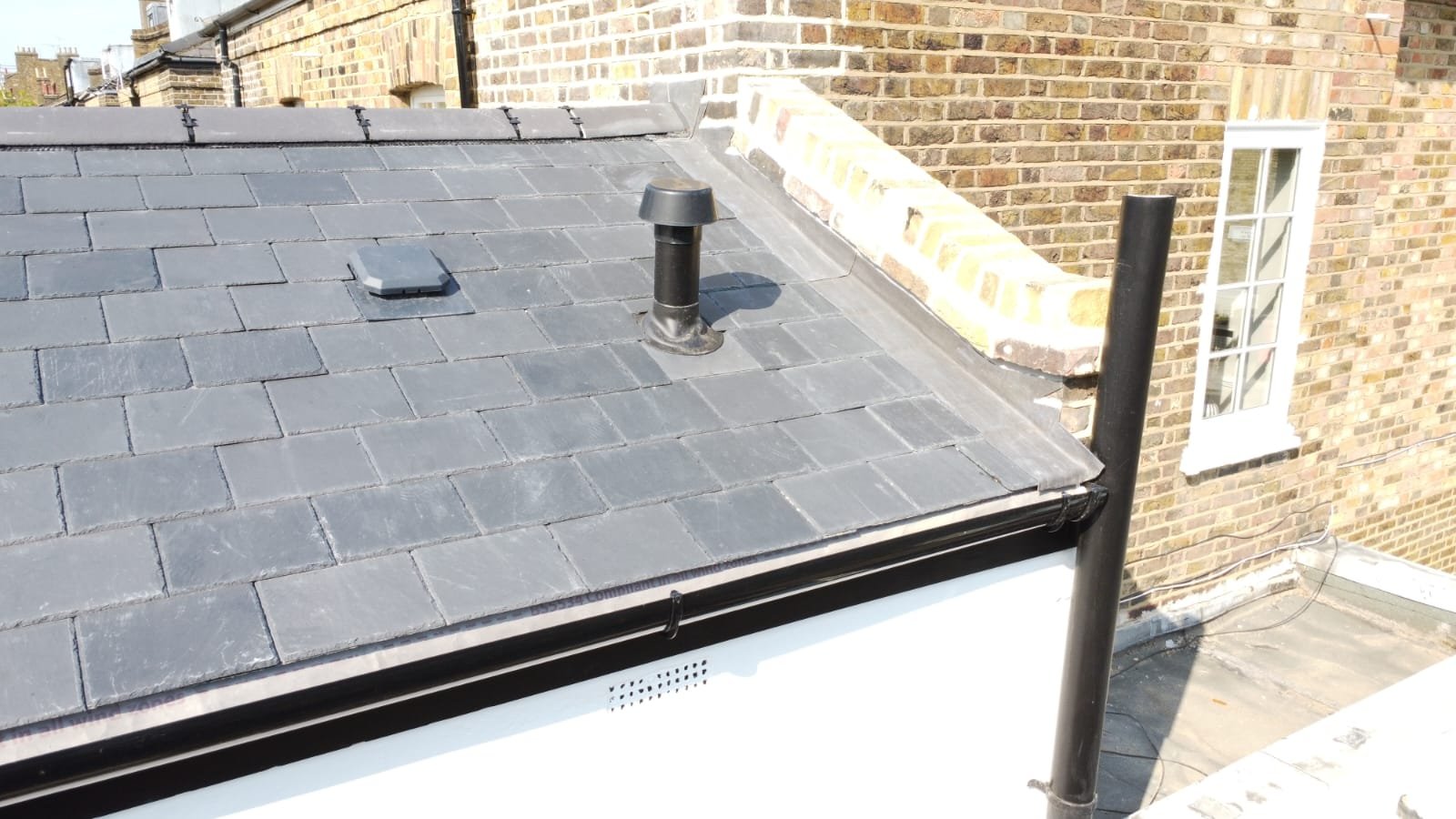
A damp patch on the chimney breast, a brown stain under the parapet or a leak that only appears in driving rain usually means a chimney repair is due. On London terraces, these problems generally trace back to the same few details at the top of the house. These are chimney stacks, lead flashing and parapet walls. They face the worst weather and are easy to ignore because you can’t see them from the street. This guide explains how each one works, how it fails, and how a chimney repair fixes it.
Signs you need a chimney repair
- Damp patches or staining on the chimney breast, especially after heavy rain.
- Damp in the loft around the stack, or wet timbers next to it.
- Lead flashing that has lifted, split or come out of the mortar joint.
- Cracked or missing mortar on the stack, or a leaning stack.
- Loose, cracked or missing chimney pots, or a crumbling crown (the mortar cap on top).
- Plants growing from the stack or parapet.
How lead flashing works: stepped, cover and apron flashing
Specifically, flashing seals the joint between the roof covering and a wall or chimney:
- Apron flashing runs across the front (downhill side) of the chimney and dresses down over the slates.
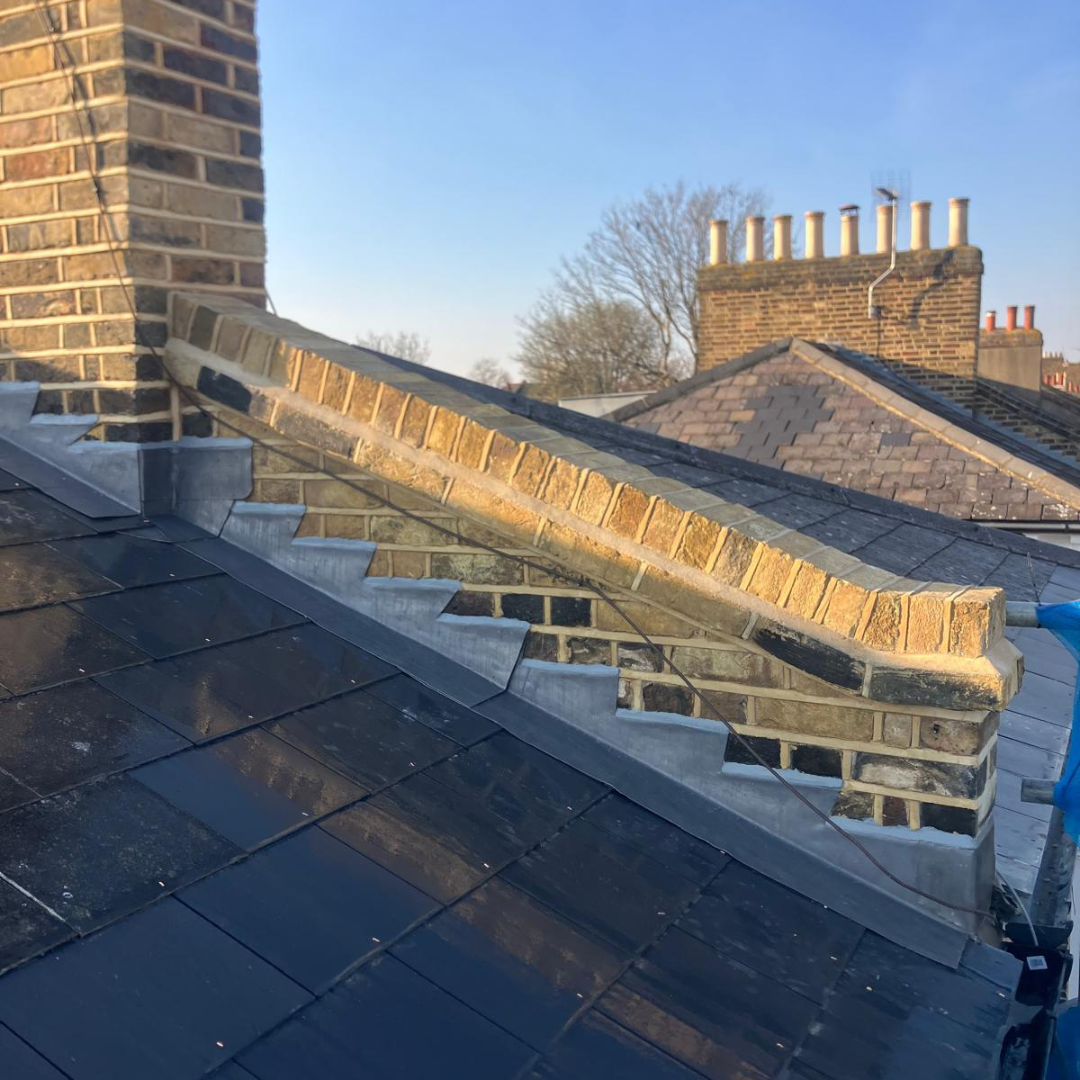
- Stepped flashing runs down the sides of the stack, cut into steps that follow the brick courses, usually with soakers under the slates.
- Back gutter sits on the uphill side of the stack and then turns water around it.
- Cover flashing tucks into a mortar joint and covers the top of an upstand, for example on parapet gutters and abutments.
The roofer wedges each piece into a mortar joint and points it. When the pointing falls out or the lead splits, water gets behind it. That is often the source of the damp patch on the chimney breast.
Chimney repair options: repointing, rebuilds, crown and pots
- Repointing: chimneys take more weather than any other brickwork, so their joints fail first. Repointing in lime keeps the stack sound, as our brick repointing guide explains.
- Rebuilding: if a stack is leaning, badly cracked or spalled, it may need taking down to a sound level and rebuilding with matching bricks.
- Crown (flaunching): the mortar cap around the pots sheds water. However, a cracked crown lets water straight down into the stack.
- Pots and caps: a roofer should re-bed any loose pots. Also cap and ventilate disused flues, so rain stays out but the flue can still breathe.
★★★★★
“The project involved extensive work, including the repointing of our chimney stacks, installation of new lead loft boxes and windows, a complete restructuring, replacement of coping stones, and reinforcement of party walls.”
Matteo D. · Google review, 2025

What is a parapet wall, and why do parapet gutters leak?
A parapet is the section of wall that rises above the roof line, particularly along the front of a London terrace or between neighbouring houses. Behind a front parapet there is generally a hidden gutter, lined with lead or asphalt, that carries water to an outlet.
Parapets generally fail in a few predictable ways:
- Copings: cracked or missing coping stones let water into the top of the wall, so the brickwork below gets soaked.
- Gutter linings: split lead or cracked asphalt in the parapet gutter lets water run into the front wall, especially in heavy rain.
- Outlets: when outlets or hoppers block, the gutter overflows behind the parapet.
- Movement: if a parapet is cracked or leaning, it may need rebuilding.
A failing parapet gutter is one of the six common causes in our guide to a leaking roof.
Chimney repair on shared stacks: the Party Wall Act
On a terrace, you often share chimney stacks and parapets with the neighbours. Under the Party Wall etc. Act 1996, repairing, rebuilding or cutting into a party wall or structure may mean you need to serve notice on your neighbour before work starts. Whether your job needs a notice depends on the details, so check before you book the work. Removing a chimney breast also needs Building Regulations approval.
Case study: parapet wall rebuild & lead flashing, London Fields
At a house near London Fields in East London, we rebuilt a damaged parapet wall and installed new lead flashing to spec. On another project we also restored parapet walls with lead-capped parapets and a lead loft box.
★★★★★
“We recently had our chimneys, roof and guttering redone by BARL, they were absolutely fantastic and surpassed our expectations.”
Constantine S. · Google review, 2026
We carry out chimney repair, flashing and parapet work across Hackney, Islington, Marylebone and the rest of North, East and Central London. See our chimney services and leadwork services.
Where we work in London
Frequently asked questions
A parapet wall is the part of an external or party wall that rises above the roof line. On London terraces it usually runs along the front of the house and hides a parapet gutter behind it. As a result, parapets need sound copings and gutter linings to stop water getting into the wall below.
Correctly installed lead is very long-lasting. However, flashings often fail sooner because the mortar holding them into the wall erodes. So repointing the flashing joints is a common repair.
Common causes are rain getting into the stack through failed pointing, a cracked crown or an uncapped flue, or failed lead flashing where the stack meets the roof. Salts left in old flues can also draw moisture. Generally, a close inspection of the stack finds the source.
Most chimney repair work needs safe access at height, usually a chimney scaffold. Some small flashing repairs can be done from roof ladders on a suitable roof, but most repointing and rebuilds need scaffolding.